Today at Goldman Sachs 10KSB, we started Module 1 where I was introduced to the concept of a “business will.” I have a last will and testament from my time in the Marine Corps. And I have a maniacal focus on making sure my family is cared for when I die. But what happens to my business? I realized that my businesses don’t have a will and they are 100% owned by me.
Our lecturers hit us with the truth: “Death is not an exit strategy.”
Maybe when you die, you still had a bunch of clients waiting for completion on contractual obligations only you could perform. What happens then? Will your spouse get sued for nonperformance? Will that detract from the wealth of your estate? If you have many employees depending on you, do their jobs just go up in smoke the very moment you pass away? Do people have passwords and logins necessary to run the business? Do your partners and associates know where you keep valuable documents and have access to them in the event you die?
Through answering these questions, we were forced to think about possible exit strategies for our businesses. You could:
(1) sell to a strategic buyer,
(2) sell to a financial buyer,
(3) sell or pass down to family or heirs,
(4) sell to employees and partners,
(5) go public,
(6) close down or liquidate, or
(7) go bankrupt.
But again . . . Death is not an exit strategy!
Have you thought about writing a “business will”? If so, what does it entail?
Benjamin Graham’s seminal work, “Security Analysis,” starts with this foreboding quote by the Roman philosopher, Horace:
“Many shall be restored that now are fallen and many shall fall that are now in honor.”
Graham lost everything during the Great Depression, so it is no wonder that he highlights the staggering reversal of fortunes that can happen seemingly overnight if a person is not vigilant. That’s why my word of the year for 2023 is “VIGILANCE.”
Colonel Boyd, who developed the OODA loop, believed that “observation,” the first part of the loop, was critical to informing our later actions. And what do we now observe? We see rising inflation, supply chain breakdowns, demographics issues, political instability, war and the threat of war, uncertainty in the markets, the list goes on. Still, I believe we can remain vigilant and prepare for stormy weather.
Financially, we can do this by having a lot of cash in reserve. Warren Buffett is widely know to be sitting on a cash pile of over $100 billion dollars, ready to scoop up opportunities during a recession. In health, we can keep good habits to prolong our lives as much as possible while waiting on scientific breakthroughs. Dr. David Sinclair, chair of genetics at Harvard, has previously stated that we’re nearing a sort of escape velocity, where the longer we live, the better science becomes — so much that in the near future, we may be able to add greater than one year of life for every additional year that we live. Finally, we can be vigilant about our time, giving it up only to those activities that serve us rather than take away from the legacy we’re trying to build.
How do you prepare for stormy weather? What is your word for the year?
Peter Drucker is noted for saying, “Culture eats strategy for breakfast.” In our Goldman Sachs 10KSB meeting today, we talked about what that means.
To help me understand this, I made the analogy that culture is like Commander’s intent in the Marine Corps. The Commanding Officer might say “take that hill.” What he doesn’t do is say, “Take that hill by doing X, Y, and Z.” Circumstances might change to make that strategy untenable or obsolete. You can’t plan for every eventuality. So rather than doing that, Marines know that the general intent or culture is to “close with and destroy the enemy.” With that as their overarching goal, “take that hill” can be achieved in many different ways. So it’s the same with culture.
Having a culture of integrity means that you don’t have to outline every ethically challenging situation and how to react in each instance. Having a culture of integrity would mean acting in a way that your good reputation stays intact before, during, and after such an encounter. A rule for every occasion is strategy (and also impossible!), but a culture consists of the core values that guide the independent thought of key members of your organization. It’s fluid, just like your business. And that’s why culture eats strategy for breakfast!
The sit-to-stand test is a helpful measure of longevity.
The sit-to-stand test is a measure of functionality in your lower extremities. Because it is said that breaking a hip in your old age is worse than getting cancer, studies have show that this simple test can be a good determiner of longevity.
From the standing position, if you can lower yourself to a cross-legged, seated position and then raise yourself back up without the use of your hands or perching up on your knees, then you’ve scored a perfect 10. If you wobble (minus 1/2 point) or need assistance from other limbs (minus 1 point) to press yourself up, then you’ve got some work to do!
I do a quick sit-to-stand test every morning to check my balance and lower body strength. Is this something you might incorporate into your morning routine?
I am fan of routines and the settling effect they have on me, especially when I travel a lot. One of the routines I got into was this priming exercise led by Tony Robbins. I started to do it every day for a week, then every other day, and then finally once a week or month.
Tony begins with some forceful breathing to energize and invigorate you. This is followed by some visualization of everything good in your life — your goals, your happy coincidences, what good you desire for others in your life. I compare it to a more vibrant or active form of meditation.
Also, this reminds me of a couple studies that show when you imagine scenarios, like your own future success, with extra vivid, painstaking detail, down to the color of your socks when you launch your first public company (or whatever goal you may have), it’s more likely to be ingrained and internalized for your subconscious mind to begin acting upon. Plus, it’s fun to dance and celebrate at the end!
I remember reading some partnership letters from Nick Sleep and Zak Zakaria’s Nomad Fund. In one of them, a shareholder was complaining about a particular investment that Nomad ventured into which was based in Zimbabwe. The shareholder’s main complaint? That Zimbabwe did bad things and it was immoral to support any investment in that country.
Sleep and Zakaria’s response though was the opposite of what you’d think. Instead of pulling capital, they remained invested in this company; they (I think rightly) reasoned that the only way to affect change is to remain engaged with the party whose mindset you’d like to shift.
What? No canceling? No scapegoating? No scorched earth?
No, the answer is simply to remain in communication. Understand the other side’s perspective and perhaps find a way to “grow the pie.”
Stuart Diamond, author of the book “Getting More” and famed negotiations instructor at Wharton business school, says the same thing. When an opposing party wants to leave the room after things get heated, he often says words to the effect of, “Yes, you can leave and you’ll be fine. But if you stay in this room, you’ll probably get more.” More of what you want and more of what you didn’t even know you wanted but later found out you wanted through continued engagement.
Is it possible that we’ve been approaching human affairs all wrong lately? Can we gain more as a society by staying in communication versus shunning opposition? Asking questions versus spewing bitter diatribes? Staying on the court versus cancelling the game altogether?
In my time as a Marine and in business, I’ve often come across young leaders that say things like, “Reading is just not for me,” “I don’t like reading,” or “I’m too busy to read.” In the Marine Corps, each rank from entry level enlisted all the way up to General has their own reading list. It’s the way we develop what’s called a “thousand year old mind.” That is the ability to recognize patterns of history and thought that give you wisdom well beyond your years. When a youngster says that they can’t read for whatever reason, it’s equivalent to saying, “No, I don’t want the competitive edge you’re offering, I’d rather lose.” And in war, the consequences of losing are final. We don’t want that outcome and so we read.
General James Mattis, former Secretary of Defense, once had an officer say the same thing to him, “I’m too busy to read.” What follows is his well thought out response that will hopefully persuade everyone to pick up a book, gain hundreds of years of wisdom, and avoid unnecessary suffering.
“The problem with being too busy to read is that you learn by experience (or by your men’s experience), i.e. the hard way. By reading, you learn through others’ experiences, generally a better way to do business, especially in our line of work where the consequences of incompetence are so final for young men.
Thanks to my reading, I have never been caught flat-footed by any situation, never at a loss for how any problem has been addressed (successfully or unsuccessfully) before. It doesn’t give me all the answers, but it lights what is often a dark path ahead.
With [Task Force] 58, I had w/ me Slim’s book, books about the Russian and British experiences in [Afghanistan], and a couple others. Going into Iraq, “The Siege” (about the Brits’ defeat at Al Kut in WW I) was req’d reading for field grade officers. I also had Slim’s book; reviewed T.E. Lawrence’s “Seven Pillars of Wisdom”; a good book about the life of Gertrude Bell (the Brit archaeologist who virtually founded the modern Iraq state in the aftermath of WW I and the fall of the Ottoman empire); and “From Beirut to Jerusalem”. I also went deeply into Liddell Hart’s book on Sherman, and Fuller’s book on Alexander the Great got a lot of my attention (although I never imagined that my HQ would end up only 500 meters from where he lay in state in Babylon).
Ultimately, a real understanding of history means that we face NOTHING new under the sun.
For all the “4th Generation of War” intellectuals running around today saying that the nature of war has fundamentally changed, the tactics are wholly new, etc, I must respectfully say … “Not really”: Alex the Great would not be in the least bit perplexed by the enemy that we face right now in Iraq, and our leaders going into this fight do their troops a disservice by not studying (studying, vice just reading) the men who have gone before us.
We have been fighting on this planet for 5000 years and we should take advantage of their experience. “Winging it” and filling body bags as we sort out what works reminds us of the moral dictates and the cost of incompetence in our profession. As commanders and staff officers, we are coaches and sentries for our units: how can we coach anything if we don’t know a hell of a lot more than just the [Tactics, Techniques, and Procedures]? What happens when you’re on a dynamic battlefield and things are changing faster than higher [Headquarters] can stay abreast? Do you not adapt because you cannot conceptualize faster than the enemy’s adaptation? (Darwin has a pretty good theory about the outcome for those who cannot adapt to changing circumstance — in the information age things can change rather abruptly and at warp speed, especially the moral high ground which our regimented thinkers cede far too quickly in our recent fights.) And how can you be a sentinel and not have your unit caught flat-footed if you don’t know what the warning signs are — that your unit’s preps are not sufficient for the specifics of a tasking that you have not anticipated?
Perhaps if you are in support functions waiting on the warfighters to spell out the specifics of what you are to do, you can avoid the consequences of not reading. Those who must adapt to overcoming an independent enemy’s will are not allowed that luxury.
This is not new to the USMC approach to warfighting — Going into Kuwait 12 years ago, I read (and reread) Rommel’s Papers (remember “Kampstaffel”?), Montgomery’s book (“Eyes Officers”…), “Grant Takes Command” (need for commanders to get along, “commanders’ relationships” being more important than “command relationships”), and some others.
As a result, the enemy has paid when I had the opportunity to go against them, and I believe that many of my young guys lived because I didn’t waste their lives because I didn’t have the vision in my mind of how to destroy the enemy at least cost to our guys and to the innocents on the battlefields.
Hope this answers your question…. I will cc my ADC in the event he can add to this. He is the only officer I know who has read more than I.
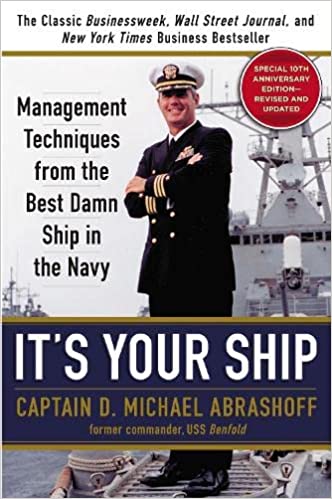
It’s Your Ship: Management Techniques from the Best Damn Ship in the Navy
A couple years ago, I read Captain Mike Abrashoff’s book, “It’s Your Ship: Management Techniques from the Best Damn Ship in the Navy.” It came highly recommended from my mentor and I eventually received executive coaching from Captain Abrashoff’s performance company, Aegis.
Captain Abrashoff committed to taking the worst operational ship in the Navy and transforming it into the best with ZERO changes in personnel. It’s a great account of all the things that a culture can do for you and proved Peter Drucker’s famous quote, “Culture eats strategy for breakfast.” Strategy is rules. Culture is a way of thinking that dictates how people act without needing a rule for every situation! Way more flexible and quick.
One great tidbit was Captain Abrashoff’s inquiry into the top 5 reasons people leave their job. While you may think it is pay, pay only ranks as the 5th reason. The top reason was not being treated with respect or dignity, the 2nd reason – being prevented from making an impact on the organization, 3rd – not being listened to, and 4th – not being awarded with more responsibility. Looking back on the various positions I’ve held in other organizations, I’ve often experienced combinations of 4 or even all 5 of these management errors, which fortunately led me to start my own businesses.
Are you making these same mistakes in your business? If not, congratulations on running the best “ship” in your industry!
I once read an article that said the person that’s going to live to the age of 150 has already been born. Ever the optimist, I immediately thought, “Well, of course, it’s me!” How happy I was to hear Dr. David Sinclair, professor of genetics at Harvard University, say the same thing.
I recently read Dr. Sinclair’s book, “Lifespan: Why we age and Why we don’t have to.” It kicked my butt into gear as far as doing the things required to attain the type of health that gets you to 150 years old — things like a good BMI, biomarkers like blood glucose level within a certain optimal range, taking different supplements, etc.
For every year you live in a healthy state, you increase the chance that a medical breakthrough that will prolong your life will be made available for your use. Additionally, for every year you live in a healthy state, you may in the future be able to gain MORE than an additional year of healthy life with new medical advancements. I highly recommend Dr. Sinclair’s series of podcasts where he and his co-author, Matt LaPlante, review the basic tenets of their book and the research that supports their claims. There are 8 in total that last about an hour each and are full of wisdom for vibrant and healthy living.
A Beginners Guided Breathing with the Iceman, Wim Hof.
Breath. It’s pretty surprising to find out after decades of breathing that you might be doing it wrong! That’s what happened to me when I discovered James Nestor’s book “Breath.” I always thought that breathing out of your mouth when you were doing strenuous exercise was a sign of how hard you’re working, a point of pride. Little did I know that your nose has all sorts of special receptors and filters (which your mouth doesn’t not have) to make sure that the air you breath is fit for consumption. Mouth breathing is not ideal!
Another person that helped me take a different look at breath is Wim Hof. Wim is a free spirit that genuinely wants the best for everybody. He has an amazing story that led to him discovering breathwork. It began with his path to healing from his wife’s suicide and evolved to later demonstrating under scientific observation that you can supercharge the autonomic nervous system to fight off endotoxins on command! This is powerful stuff, my friends!
Wim makes it pretty simple to get started on this journey of discovering the benefits of proper breathing with this video of 3 rounds of 30 breaths with a breath hold between each round.
Try it first thing in the morning before you’ve eaten and see how you feel!




 One Ladder Project